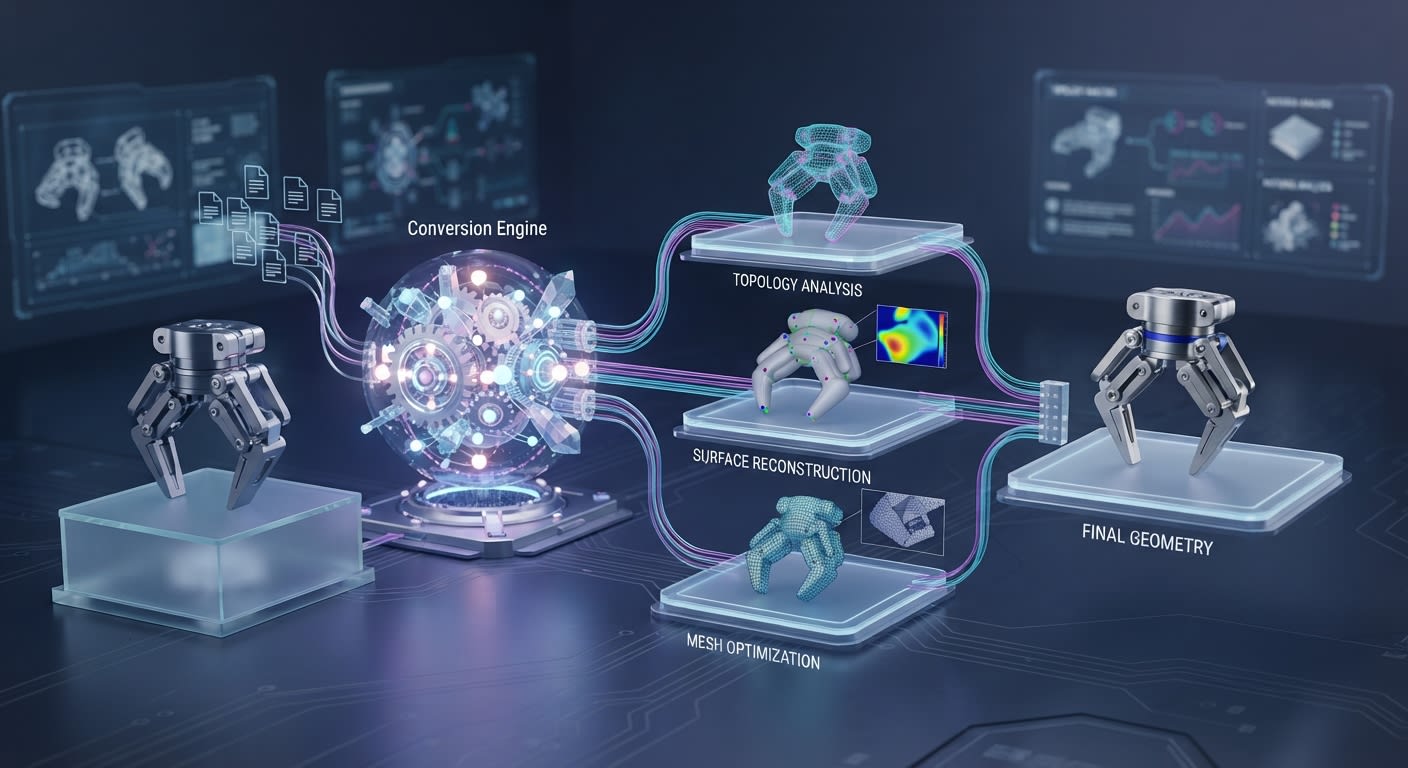
Complex CAD applications need a dependable foundation for creating, editing, analyzing, and managing three-dimensional models. A geometric kernel provides many of the fundamental capabilities required to process solids, surfaces, curves, edges, and other geometric entities. For developers building professional engineering software, choosing appropriate geometric technology can affect modeling accuracy, application performance, and the ability to support increasingly demanding workflows.
A capable kernel does more than represent shapes. It provides operations that allow applications to construct and modify models while maintaining relationships between geometric and topological elements. This foundation can help developers concentrate on application-specific features instead of implementing every underlying geometric calculation independently.
Solid Modeling Capabilities
Solid modeling is central to many CAD applications. Engineers need to create digital representations of physical components and modify them throughout the design process.
A geometric foundation can support operations such as creating primitives, combining bodies, removing material, transforming objects, and performing Boolean calculations. These functions allow developers to build applications capable of handling detailed mechanical components and assemblies.
Accuracy is particularly important when models are later used for manufacturing, simulation, inspection, or other downstream processes.
Surface Modeling for Complex Forms
Many products contain curved and highly detailed surfaces that require more than basic solid primitives. Surface modeling provides tools for creating and modifying these shapes.
Kernel capabilities may include curve-based surface construction, trimming, extending, joining, and other operations. These functions can support applications for products where complex external forms are important.
Developers should test surface functionality using realistic models because intricate geometry can reveal limitations that are not apparent with simple examples.
Curves and Wireframe Geometry
Curves and wireframe entities are useful in many engineering workflows. They can represent profiles, construction geometry, boundaries, and other elements used to create or analyze three-dimensional models.
Supporting these entities gives developers additional flexibility when designing specialized CAD tools. Applications can combine wireframe, surface, and solid representations according to the requirements of a particular workflow.
Topological Relationships
Complex CAD models require more than geometric definitions. Applications also need to understand how faces, edges, and vertices are connected.
Topology provides this structural information. A capable geometric foundation can maintain these relationships as models are created and modified.
Reliable topology management is important for operations such as Boolean calculations, face selection, edge processing, and model inspection. It can also help applications maintain a consistent representation as users perform repeated editing operations.
Advanced Modeling Operations
Professional CAD applications often require sophisticated geometric calculations. These may include intersections, projections, offsets, transformations, fillets, and other modeling operations.
Developing such functionality independently can require substantial mathematical expertise and testing. A specialized kernel can provide foundational algorithms that developers can incorporate into their applications.
Testing complex edge cases is essential because advanced operations can behave differently when applied to intricate models or closely connected features.
Precision and Robustness
CAD models can contain small features, complex intersections, and detailed surfaces. A geometric foundation needs to process these elements consistently.
Developers should evaluate how the technology handles difficult geometry, repeated modifications, and unusual model conditions. Robustness can be particularly important when the resulting models are passed to manufacturing or other downstream engineering applications.
Using representative production data during testing can provide a more realistic assessment than relying solely on sample files.
Performance With Large Assemblies
Complex CAD applications may need to process assemblies containing thousands of components. The geometric foundation should therefore be evaluated for processing speed and resource requirements.
Developers can measure model loading, geometric operations, memory consumption, and responsiveness with large datasets. These tests can reveal potential bottlenecks and help teams design an architecture that scales with model complexity.
Integration With CAD Applications
The geometric foundation is typically one part of a broader software architecture. Applications may combine it with visualization, file conversion, model management, measurement, and specialized engineering functions.
A modular approach can make it easier to integrate these capabilities and maintain the application over time. Developers should consider how well the geometric technology fits their programming environment and deployment requirements.
Building Reliable Complex CAD Software
A strong geometric foundation can provide the essential capabilities required by sophisticated CAD applications. Solid and surface modeling, curve processing, topology management, advanced operations, precision, and performance all contribute to the quality of the final software.
For development teams, evaluating these capabilities with realistic engineering models is an important part of selecting technology. By combining reliable geometric functionality with effective visualization, data exchange, and application-specific workflows, developers can create CAD solutions capable of handling complex models while remaining adaptable to changing engineering requirements. 3D Software Tools for CAD, CAM, CAE and BIM Development
#GeometricModeling #BRep